Why drain the Amalfi Coast of its famous color? The region is famous for it—the cerulean sea, the pastel-painted houses stacked like children's blocks against the cliffside, the impossible green of lemon groves cascading toward the water. It is, by any measure, one of the most photographed coastlines in the world, and almost always in saturated, sun-drenched color.
In his short film No More What Ifs, Andrew Amisola does something unexpected: he removes it all. Shot on a Fujifilm X-H2S in 6K Open Gate and processed through Dehancer's film emulation, the result is a work that feels less like a travel film and more like a meditation on the nature of memory itself—how we hold onto places, and how they hold onto us.
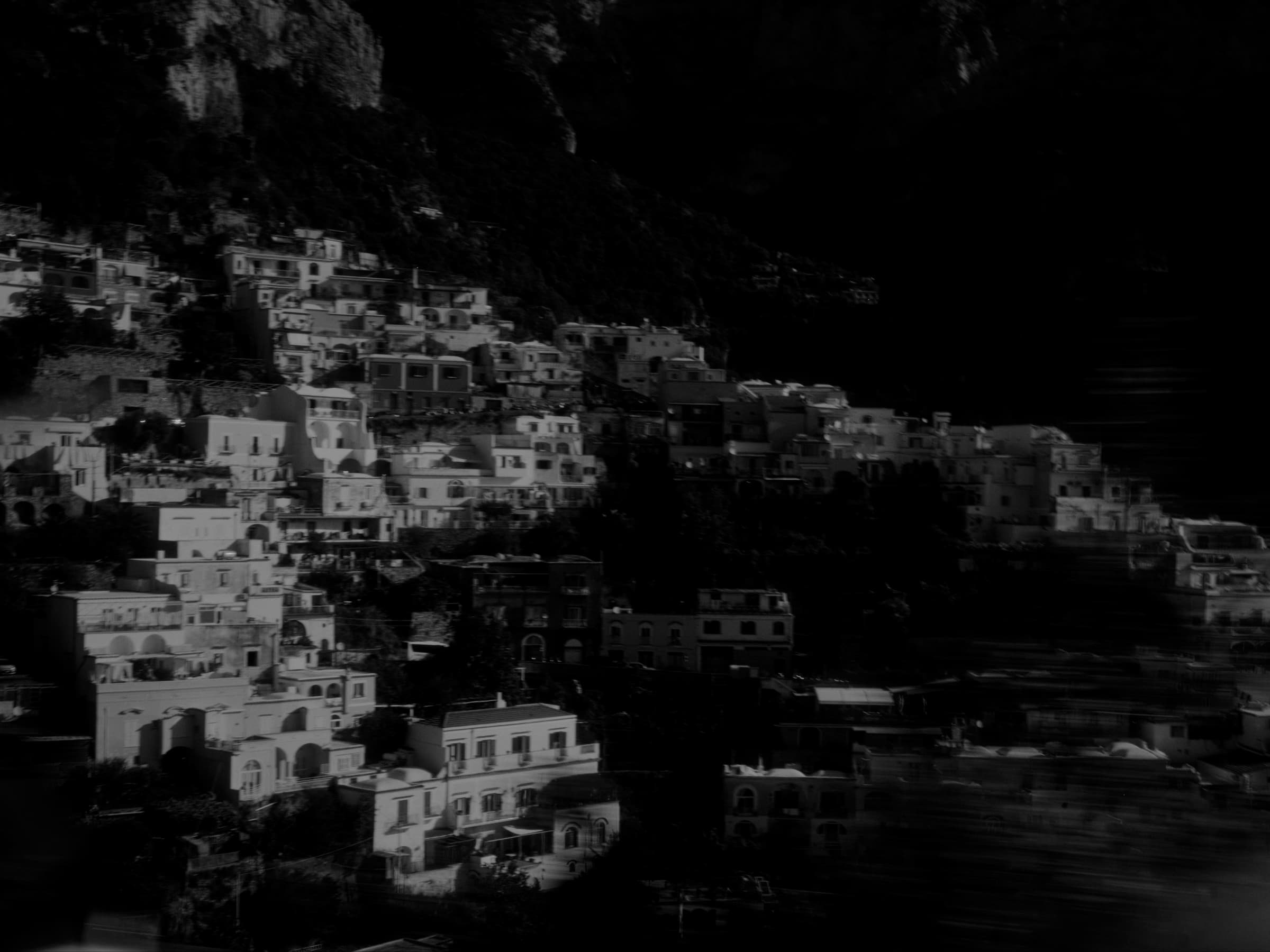
The film wastes no time. A voice—Amisola's own—arrives almost immediately: "It got to a point where I had to tell myself: no more what ifs. And I realized a much better saying is... what now?"1 The confession lands, and then the title card appears against a dark mountain silhouette, city lights scattered along the water. An orchestral swell from The 8-Bit Big Band's jazz arrangement rises beneath it—a cover of "No More What Ifs" from Persona 5 that carries its own weight of nostalgia and resolution.2
"It got to a point where I had to tell myself: no more what ifs. And I realized a much better saying is... what now?"
This is not merely a landscape film. It is a reckoning, announced upfront and then explored through image.
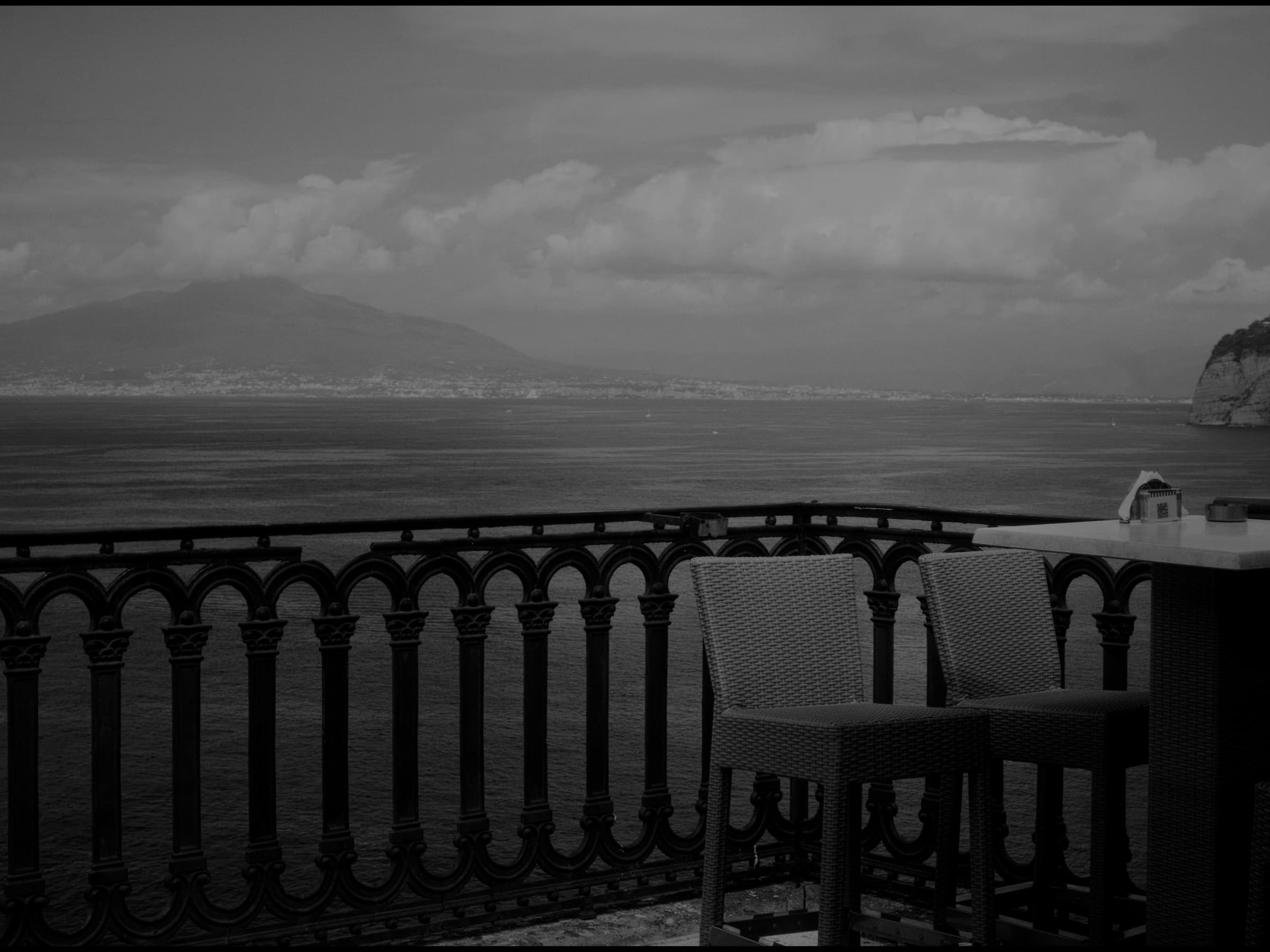
The film opens proper on a terrace—two empty chairs facing the sea, an ornate railing, clouds layering over a distant coastline. Everything is rendered in charcoal and silver. The effect is immediate and disorienting. We know this place, or think we do. We have seen it in travel magazines, on Instagram, in the backgrounds of luxury advertisements. But stripped of color, Positano becomes something else entirely: a geometry of light and shadow, a study in texture and form.
The music choice deepens this reading. The song's original context matters: in Persona 5, it plays during moments of emotional catharsis, when characters confront the gap between who they were and who they might become. Transplanted to the Amalfi Coast, it transforms the landscape into an interior space, a theater of the mind where regret and acceptance perform their slow dance.
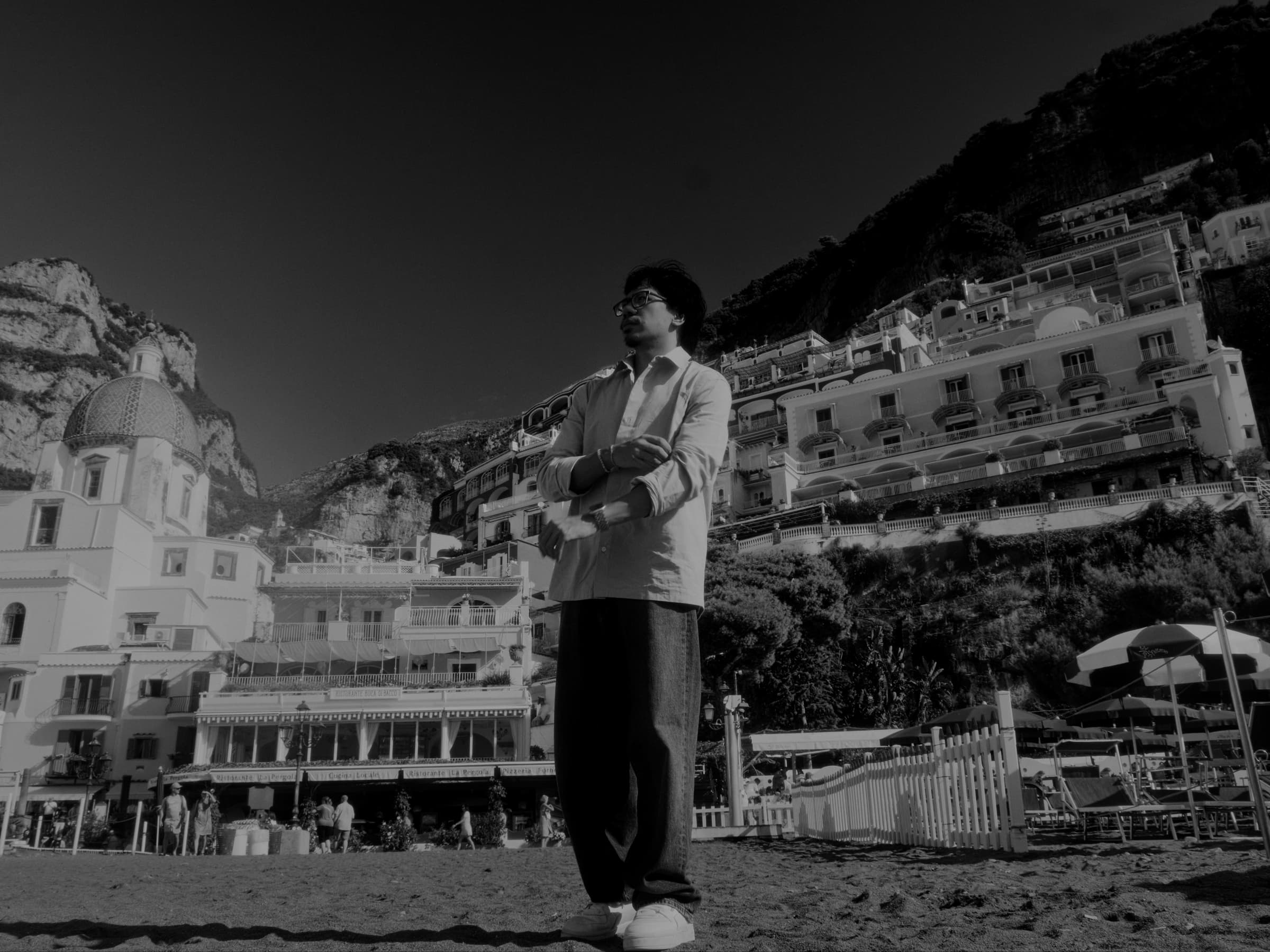
The architectural density of Positano—those famous stacked buildings clinging to the cliff face—takes on new weight in black and white. Without color to differentiate one structure from another, the town becomes a single organism, a vertical maze of stone and shadow. Amisola shoots it from multiple angles: from the beach looking up, from the hillside looking down, from aerial perspectives that flatten the topography into abstract pattern. The Dehancer processing adds grain and a subtle halation to the highlights, lending the footage the texture of memory—not quite photographic, not quite present.
There is a long tradition of artists draining famous places of their expected qualities. Hiroshi Sugimoto's Seascapes series, begun in 1980, reduces the ocean to a study in horizontal division—nothing but water, air, and the line between them, stripped of context until they become almost abstract.3 Each photograph is identical in composition: the horizon line bisects the frame exactly, the sea below, the sky above. Whether shot in the Caribbean or the Sea of Japan, the images become interchangeable, universal, timeless. Michael Kenna's night photographs of European landmarks employ long exposures that erase tourists entirely, leaving architecture floating in pools of shadow and light.4 His images of Mont Saint-Michel or the Forbidden City feel less like documents and more like dreams—places remembered rather than visited. Amisola's work exists in this lineage, though his medium—moving image rather than still photography—adds a temporal dimension that complicates the comparison. Where Sugimoto and Kenna freeze a moment, Amisola lets it breathe.
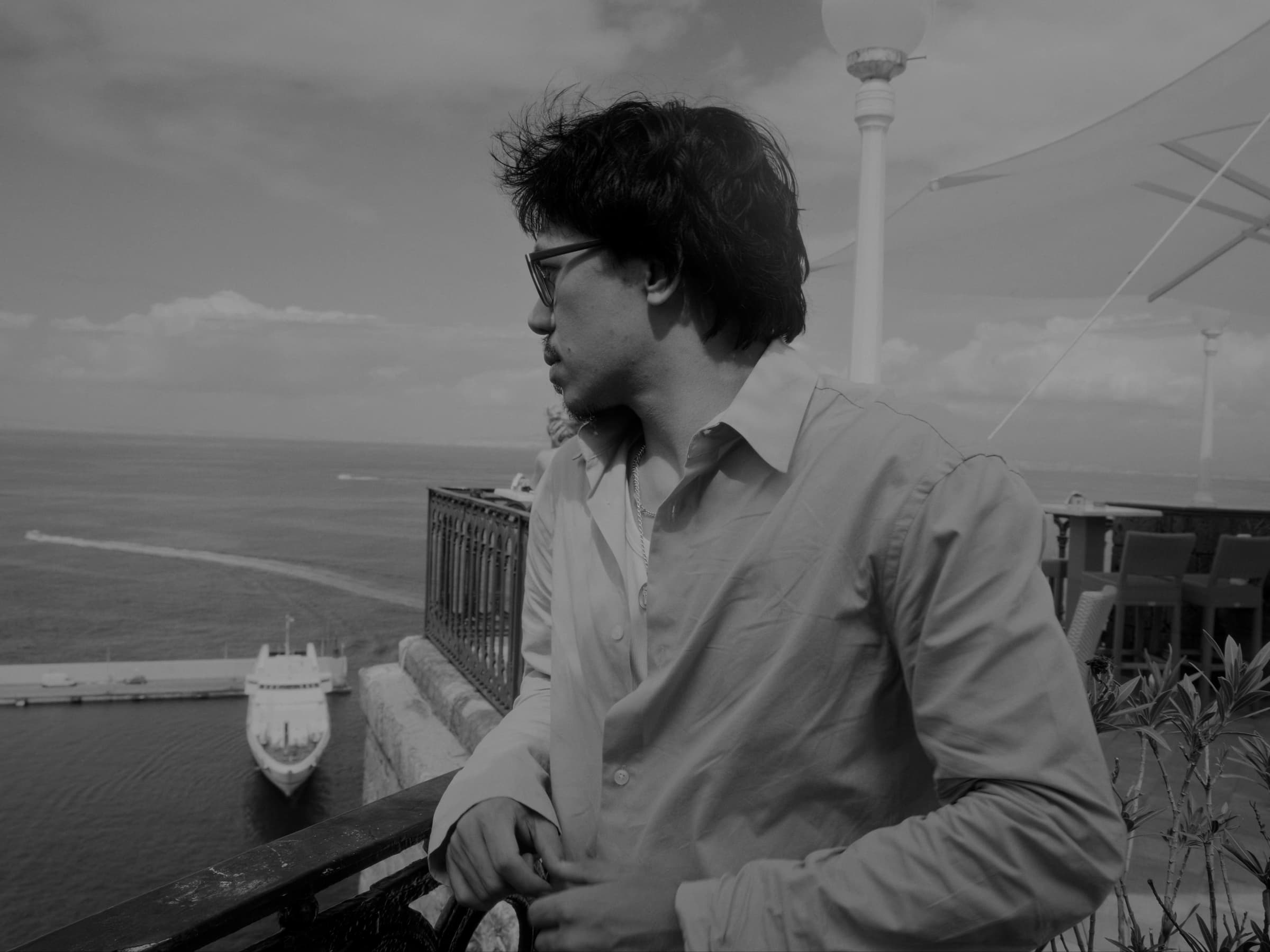
The pivot from what if to what now is the film's quiet thesis, established in its opening seconds and then embodied through everything that follows. Where the former traps us in parallel timelines—the life unlived, the choice unmade—the latter plants us firmly in the present tense. It is a question that demands movement, action, a next step. The monochrome aesthetic suddenly makes sense: by removing the seductive color of the Amalfi Coast, Amisola refuses to let us linger in fantasy. We cannot romanticize what we cannot fully see. We can only ask: what now?
The figure in that final shot—Amisola himself, though we see only his silhouette—completes a visual rhyme begun in the opening. The empty chairs faced outward; now a person does the same. The landscape has not changed, but something has shifted. The question has been answered, or at least accepted. The soft gray and silver of the closing frames feel less like absence now and more like clarity—the world seen plainly, without the filters of regret or longing.
The Amalfi Coast will continue to attract millions of visitors each year, most of whom will photograph it in the most vivid color their phone cameras can produce. Amisola has given us something rarer: a version of the place that looks the way moving on feels.
No More What Ifs is available to view on the artist's [Cinema page](/cinema/films/no-more-what-ifs).